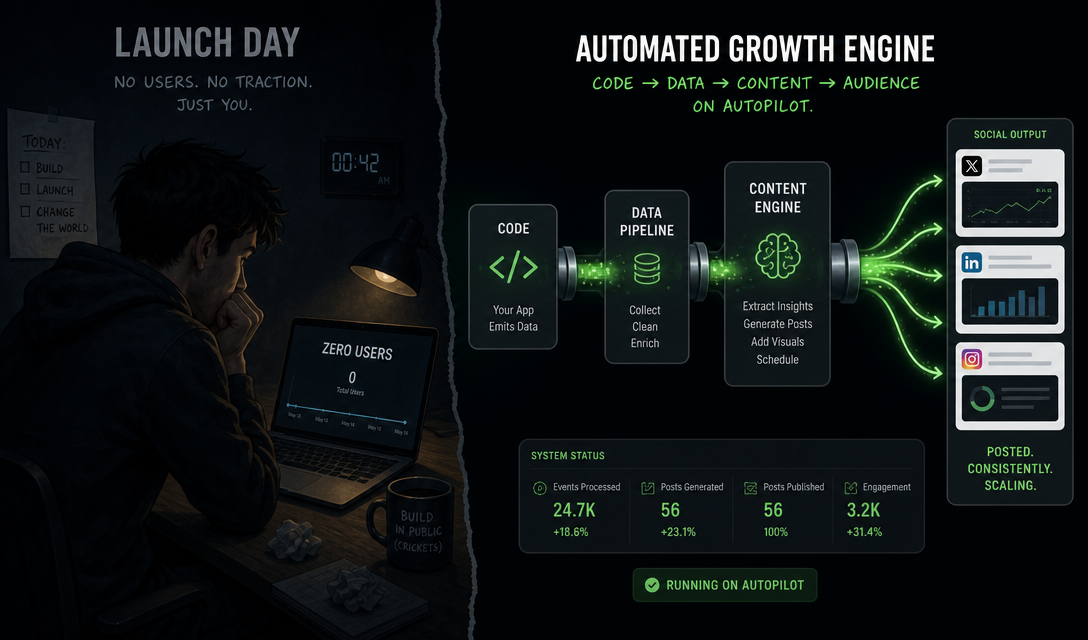
Manish Bhusal spent 10 days building PostDew — a tool that generates LinkedIn posts so founders don't have to. Three weeks after launch: zero paying customers. Ten cold DMs sent, two replies, zero signups. His Show HN post got flagged. His LinkedIn posts got no engagement.
The meta-irony is almost funny: a tool built for people who hate writing LinkedIn posts, marketed via LinkedIn posts that nobody read.
The same month, Ben Broca hit $1M ARR with Polsia — solo, zero employees, 30 days from launch. The AI handled strategic planning, cold outreach, social media, and inbox management for 1,000+ client companies simultaneously.
Same category. Same time period. Completely different outcomes.
The difference wasn't the product. It was how each founder treated distribution.
The Pattern Technical Founders Fall Into
Both founders were good builders. Manish shipped PostDew in 10 days — fast by any standard. His infrastructure cost $5/month. The product worked.
What he didn't have was a content system running alongside the product. Marketing was an afterthought — something to figure out after launch, handled manually and inconsistently.
This is the default mode for most technical founders. You build intensely. You launch. You do a few cold DMs, maybe a Reddit post, maybe a Product Hunt submission. When those don't land immediately, the energy dissipates and you go back to building.
A r/buildinpublic thread from this month documented exactly this dynamic. One founder spent 6 months manually scrolling Reddit for 2+ hours daily looking for relevant threads — finding 2-3 usable opportunities per week. The math is brutal: 10 hours of effort for a handful of conversations.
Another founder in the same thread found that posts sharing a genuine problem — with zero product pitch — got 10x more engagement than promotional content. The community insight: "The biggest wins come from genuinely joining existing conversations and providing value first, instead of direct promo."
Both are correct. Authentic, consistent community engagement works. It also takes time that most solo founders don't have.
What the High-Velocity Founders Actually Do
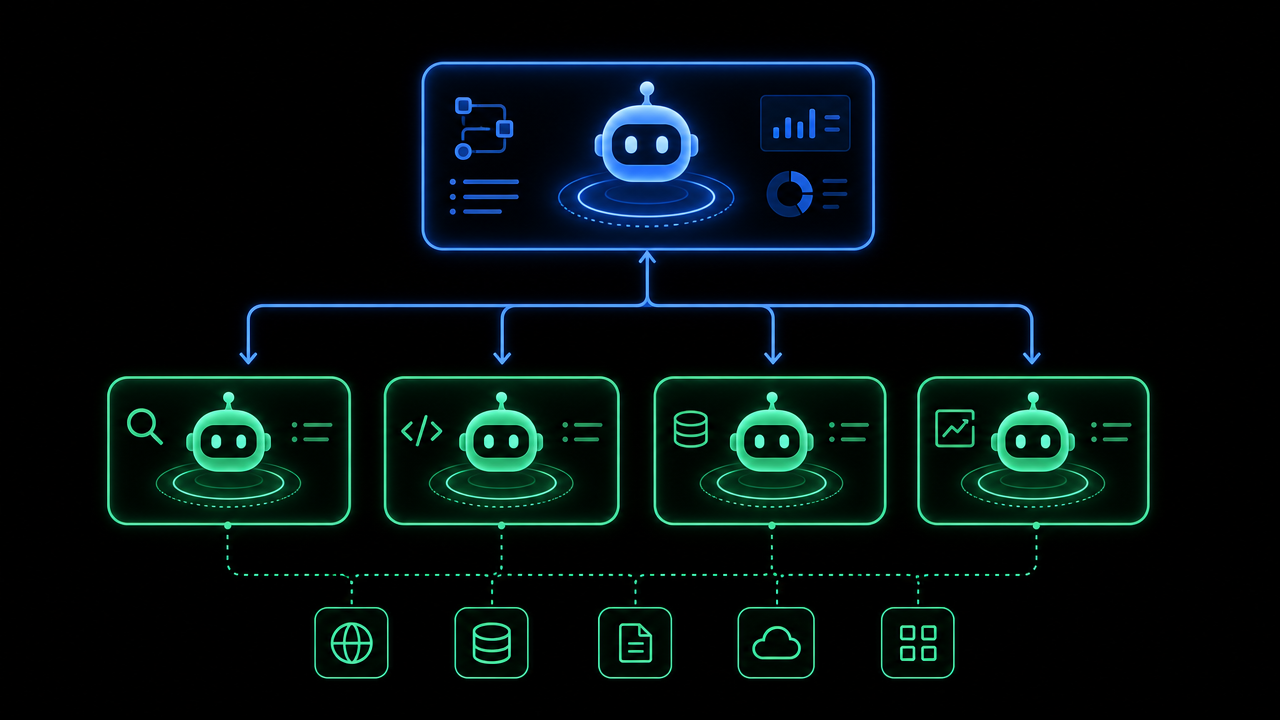
Ben Broca's approach at Polsia wasn't to do more marketing manually — it was to make marketing part of the system architecture.
Polsia uses Claude as an AI CEO and MCP as the connectivity layer to run autonomous operations across 1,000+ client companies. One of those operations: marketing. Cold emails, social media posts, ad management — all handled by AI agents that run continuously, not when the founder has time.
This isn't unique to Polsia. Look at the solo founders who've actually built durable audiences:
Pieter Levels runs a known posting routine — his content system is as much a product as his apps.
Marc Lou writes weekly updates like clockwork and crossed $1M ARR.
The pattern across all of them: content wasn't something they found time for. It was something they systematized.
Why Generic AI Content Tools Don't Solve This
The obvious response is: "I'll just use ChatGPT to write posts faster."
The problem is context. Every AI writing tool — from ChatGPT to the dedicated social media schedulers — asks you to explain your product before it can write about it. What did you ship this week? What problem does it solve? Who's it for?
You answer those questions, get a draft, edit it, paste it into your scheduler, repeat next week.
This is still a manual process. You've saved some writing time, but you haven't solved the consistency problem or the context problem. The output sounds generic because the AI had to rely on what you typed in a prompt box, not what you actually built.
The real bottleneck for solo founders isn't writing speed — it's having a system that runs without requiring you to context-switch.
Manish's PostDew was trying to solve the writing speed problem. The harder problem — the one Polsia solved for its customers — is eliminating the manual loop entirely.
What Effective AI Content Marketing Looks Like in 2026
Social media tools are bifurcating. On one side: web dashboards built for marketers who have time to sit in a browser tab and craft posts. On the other: agent-native tools built for developers who need the system to run where the work already happens.
The signal is in the tooling. SurgeGraph shipped as an MCP server and Claude Code skill in May 2026. Buffer alternatives are being built as unified APIs. SEO and content tools are racing to become agent-callable — not because it's trendy, but because developers won't leave the terminal to run marketing.
For a solo technical founder, effective AI content marketing in 2026 has a few non-negotiables:
1. It reads what you actually built, not what you describe. Context sourced from your codebase, commits, and product changelog produces content that sounds like a founder talking — not a template.
2. It runs without requiring a separate context switch. Every time you have to open a new tab, log into a dashboard, and describe your product to an AI, you've broken your flow. The best systems live where you already work.
3. It publishes consistently, not when you remember. Consistency beats quality at the distribution layer. A decent post every Tuesday beats an excellent post once a month.
4. It adapts to each platform natively. What works on X doesn't work on LinkedIn doesn't work on Hacker News. A system that applies one template everywhere produces content that gets ignored everywhere.
The Question Worth Sitting With
PostDew's problem wasn't the product — it was the launch strategy, or the absence of one. The lesson the Indie Hackers community drew: "treating marketing as an afterthought compared to the sprint of building."
Most technical founders know this. They've read it. They agree with it intellectually.
The reason it keeps happening isn't ignorance. It's that the alternative — manually building and maintaining a consistent content presence across multiple platforms — is genuinely expensive in time and attention. So it gets deprioritized.
The question to ask before your next launch: is your distribution system already running, or are you planning to figure it out afterward?
For most solo founders, that question has an uncomfortable answer. The ones who break through are the ones who treat that answer as an engineering problem.
VibeCom's Growth Autopilot is built for solo technical founders who want a content system that runs inside the IDE — reading your codebase and commits to generate and publish native posts across 10+ platforms, with a 5-minute daily review.