By May 2026, MCP servers existed for nearly every corner of the marketing stack. Amazon Ads. HubSpot. LinkedIn Ads. Meta's ad platform. Google Analytics. Klaviyo. The protocol had become the plumbing layer for AI-driven marketing workflows — connecting agents to data, campaigns, and analytics in a standardized way.
There was one notable gap: organic social content. Specifically, a purpose-built MCP server for social media that could generate platform-native posts from your actual product context — not just schedule content someone else wrote.
This post explains why that gap exists, what's in the ecosystem today, and what a real solution actually requires.
Why Every MCP Server for Social Media Gets This Wrong
Meta launched an official MCP server in April 2026. It connects to Facebook and Instagram. It handles ad management — targeting, spend, creative assets.
It does not generate organic content. It doesn't know what you shipped last week. It doesn't understand the difference between an X thread and a LinkedIn post.
That's not a criticism of Meta's product — it's doing exactly what it set out to do. But it illustrates a structural problem: every existing MCP server for social media is a distribution layer, not a creation layer.
Tools like Blotato (an MCP publishing server) let you post to 7 platforms from a Claude chat. You still write the content first. The MCP handles the last-mile delivery.
The gap is upstream: no MCP server reads your codebase, understands what you built, and generates content appropriate for each platform's culture — without you prompting it manually.
What Actually Exists in the MCP Social Media Ecosystem
As of May 2026, here's an honest map of the landscape:
Publishing-layer MCPs:
- Blotato: posts to Instagram, Facebook, LinkedIn, X, TikTok, Threads, Bluesky from a Claude chat. You create content manually in Claude, then Blotato delivers it.
- Zernio: API-first, MCP-native scheduling across 15+ platforms. Designed for developers who need unified REST APIs. No content generation.
- Buffer, Typefully, Hootsuite: used as export targets by custom MCP workflows. Not native MCP integrations.
Ad platform MCPs:
- Meta MCP (April 2026): ad management for Facebook/Instagram. No organic content.
- Amazon Ads MCP (February 2026 open beta): SP, SB, SD campaigns and DSP.
- LinkedIn Ads: available via HubSpot MCP integration.
DIY approach:
- Twitter/X automation requires building a custom MCP server using the
twitter-api-v2Node.js package. The free tier supports 1,500 tweets/month. This is a real option for developers — but it's a distribution layer you build, not content generation.
What's missing: an MCP server that reads your codebase, identifies what changed, generates platform-native posts for each channel, and delivers them to a review queue — without requiring you to manually describe your product to an AI each time.
The Real Problem: Context, Not Connectivity
The reason this gap persists is that most people defining the MCP social media problem are thinking about it as a connectivity problem. How do we post to more platforms from one place?
The actual problem for solo technical founders is a context problem. You just shipped a new feature. You know what it does and why it matters. Getting that information into a social post requires:
- Switching from your IDE to a dashboard
- Explaining your product to an AI that has no background on it
- Editing the output because it sounds generic
- Reformatting for each platform manually
- Scheduling it
- Repeating this 3-4 times per week
At step 2, most founders give up. Not because they're lazy — because re-explaining your own product to a stateless AI is genuinely tedious. The AI generates plausible-sounding content that could apply to any company in your space.
A Reddit thread on r/automation in May 2026 surfaced this cleanly: the community consensus was that 'preserving someone's actual voice consistently across platforms is the hard part. Generic content is easy.'
That's the product problem. Connectivity without context produces content that sounds like everyone else.
What a Real MCP Server for Social Media Requires
For a social MCP to actually solve the problem, it needs four things that none of the publishing-layer tools currently provide:
1. Codebase context ingestion. The server needs to read your project — commits, changelogs, README, recent diffs — to understand what's been built and why. This is not the same as reading a Notion doc you pasted in.
2. Platform-aware content generation. An X thread, a LinkedIn post, and a blog entry about the same feature require completely different writing. Word count, tone, format, culture — all different. A good MCP server generates natively for each platform rather than writing once and reformatting.
3. Persistent product memory. The server should remember your product's positioning, ICP, value proposition, and recent posts — so it doesn't start from scratch every session. Context that persists across runs is what separates a tool from a system.
4. A review layer, not full autonomy. Full auto-publish without human review is the wrong default for content. The right model: generate drafts, surface them for a 5-minute review, publish what gets approved. This preserves voice and avoids the kind of generic output that gets filtered by LinkedIn's 2026 algorithm.
How VibeCom Fills This Gap
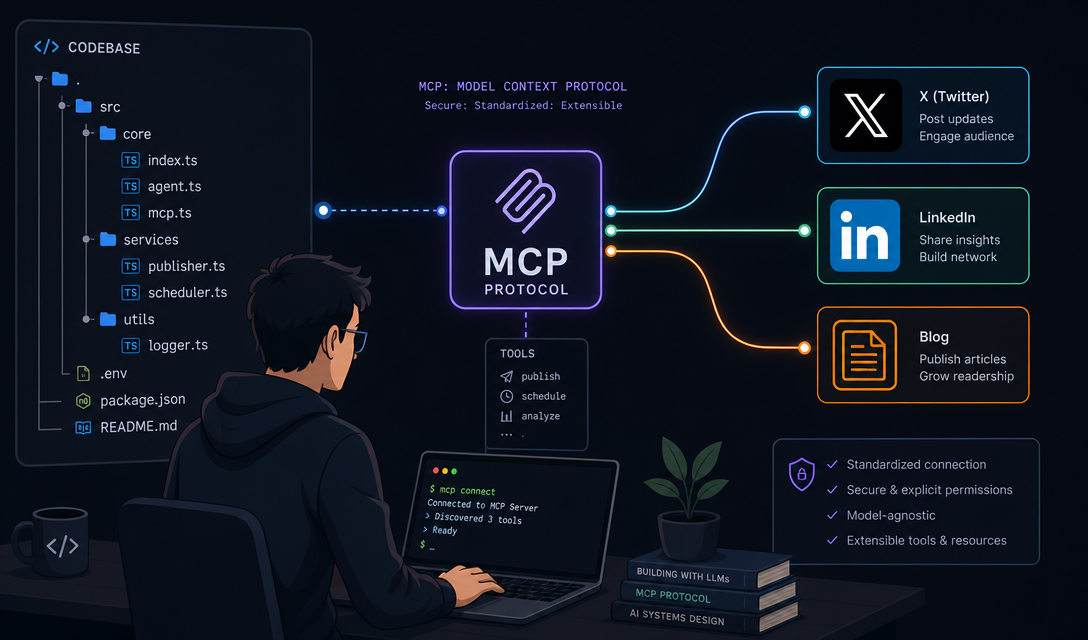
VibeCom's Growth Autopilot is built as an MCP server that lives inside Cursor, Claude Code, and VS Code. It reads your codebase and product context, generates platform-native posts for X, LinkedIn, blog, and more, and surfaces them in a daily review queue.
The workflow:
- Connect VibeCom MCP to your IDE (Cursor or Claude Code config)
- The agent reads your codebase, recent commits, and product context
- Every morning, a queue of drafts is ready — one per platform, written in that platform's style
- 5 minutes to approve, reject, or quick-edit
- Approved posts auto-publish
The key distinction from publishing-layer MCPs: VibeCom generates the content from source. It doesn't wait for you to describe your product. It reads the source of truth — your codebase — directly.
For a solo founder shipping software, this matters. The alternative is either spending 3-4 hours on marketing every day, or posting generic AI content that LinkedIn's algorithm buries.
The Window Is Now
The MCP social media ecosystem is still early. Publishing-layer tools are solving the last-mile problem. Nobody has solved the first-mile problem: getting from codebase to content without context-switching.
For technical founders building products in 2026, this is the distribution gap. Building is commoditized. Shipping code that nobody hears about is the real risk.
The MCP server for social media that actually works isn't a scheduler. It's a system that knows what you built.
VibeCom's Growth Autopilot MCP server is available at . It connects to Cursor, Claude Code, and VS Code. Growth plan is $99/month.