Loop engineering landed in developer circles in June 2026, roughly three weeks ago, when Addy Osmani published an essay defining it plainly: replacing yourself as the person who prompts the agent by designing a system that does it instead.
Peter Steinberger put it even shorter: "You shouldn't be prompting coding agents anymore. You should be designing loops that prompt your agents."
Boris Cherny at Anthropic said the same thing from the inside: "My job is to write loops."
The phrase may sound like another round of AI jargon inflation. It isn't. It describes a real shift in how people work with AI agents — and it extends well beyond coding.
The Evolution: Four Phases of Working With AI
To understand loop engineering, it helps to see what came before it.
Prompt engineering was phase one. The question was: how do I ask the model clearly enough to get a useful output? Better prompts meant better single-turn results. The human remained in every turn — reading, judging, re-asking.
Context engineering was phase two. The question became: how do I give the model the right background — files, constraints, examples, memory, conversation history — so its outputs are grounded and relevant? Context engineering recognized that a brilliant prompt with no supporting context produces brittle results.
Harness engineering was phase three. The focus shifted to the environment around the model: tools, permissions, runtime scaffolding, evaluation suites, memory stores, and guardrails. The harness is what equips a single agent run to do real work.
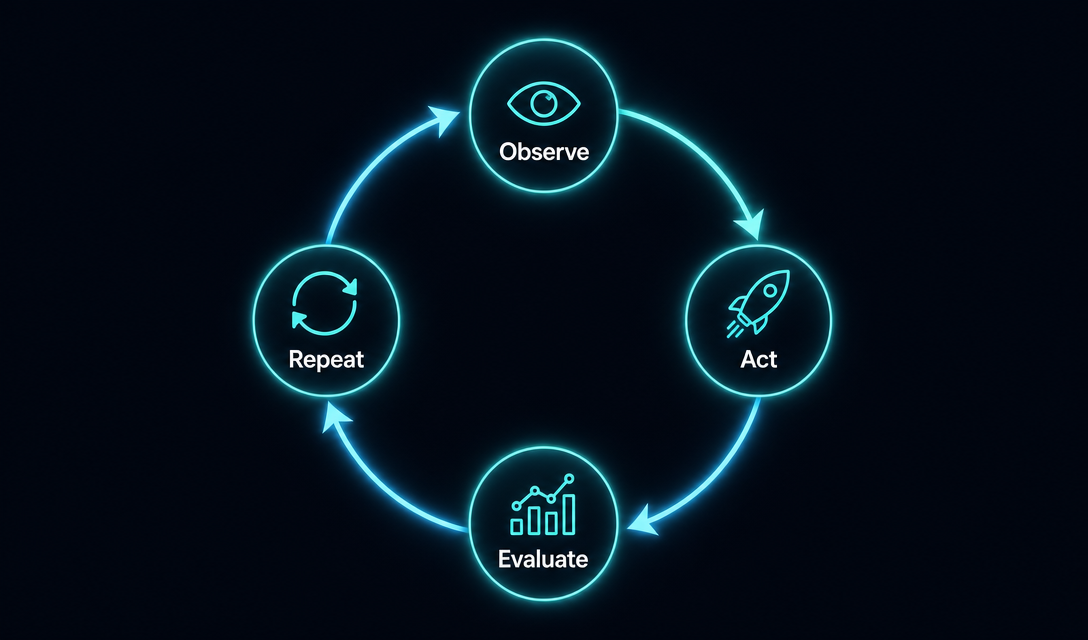
Loop engineering is phase four. The question is no longer "how do I prompt better" or "how do I equip the agent." It's: how do I design a system where the agent observes a state, takes action, evaluates the outcome, corrects course, and keeps moving toward a goal — without me manually shepherding each step?
A loop, as Osmani defines it, is a recursive goal: you define a purpose and a stopping condition, and the system iterates until it's done.
Why Coding Agents Got There First
Coding is the obvious first use case for loop engineering, and the reason is structural: code has tight, legible feedback loops.
The coding agent loop looks like this: read code → write code → run tests → inspect error logs → fix → verify. At every step, there is a clear, machine-readable signal: tests pass or fail. Diffs are inspectable. Errors have line numbers. The feedback is fast and unambiguous.
This is why the leading coding agents — Claude Code, Codex, Cursor in agentic mode — converged on loop architectures. The environment provided the feedback signal for free.
But the deeper idea doesn't belong to coding. It belongs to any knowledge workflow that repeats.
The Harder Problem: Distribution
Here's what the rise of AI coding agents has quietly created.
AI has made it faster and cheaper to build software than at any point in history. One developer, with the right tools, can ship in days what used to take a team months. The number of products launching every week has accelerated sharply.
But distribution hasn't kept up.
Search is changing — AI Overviews now appear on over 20% of queries, and click-through rates drop significantly when they do. The number of channels a product needs to show up on has grown. Communities, Reddit threads, newsletters, LinkedIn, X, SEO, GEO — each requires consistent, specific, channel-native content.
Small teams still don't have the marketing capacity to keep up. The bottleneck isn't building anymore. It's being found, understood, trusted, and chosen.
A solo founder or small team doing marketing alone faces a deeply repetitive, research-intensive, context-dependent job — one that goes quiet the moment they stop showing up.
That's a loop problem.
VibeCom Growth Agent as Loop Engineering for Marketing
VibeCom didn't coin the term loop engineering, and it's not trying to. But the concept maps directly onto what an AI marketing agent system has to do.
Compare the two loops:
Coding agent loop: read code → write code → run tests → inspect errors → fix → verify → repeat.
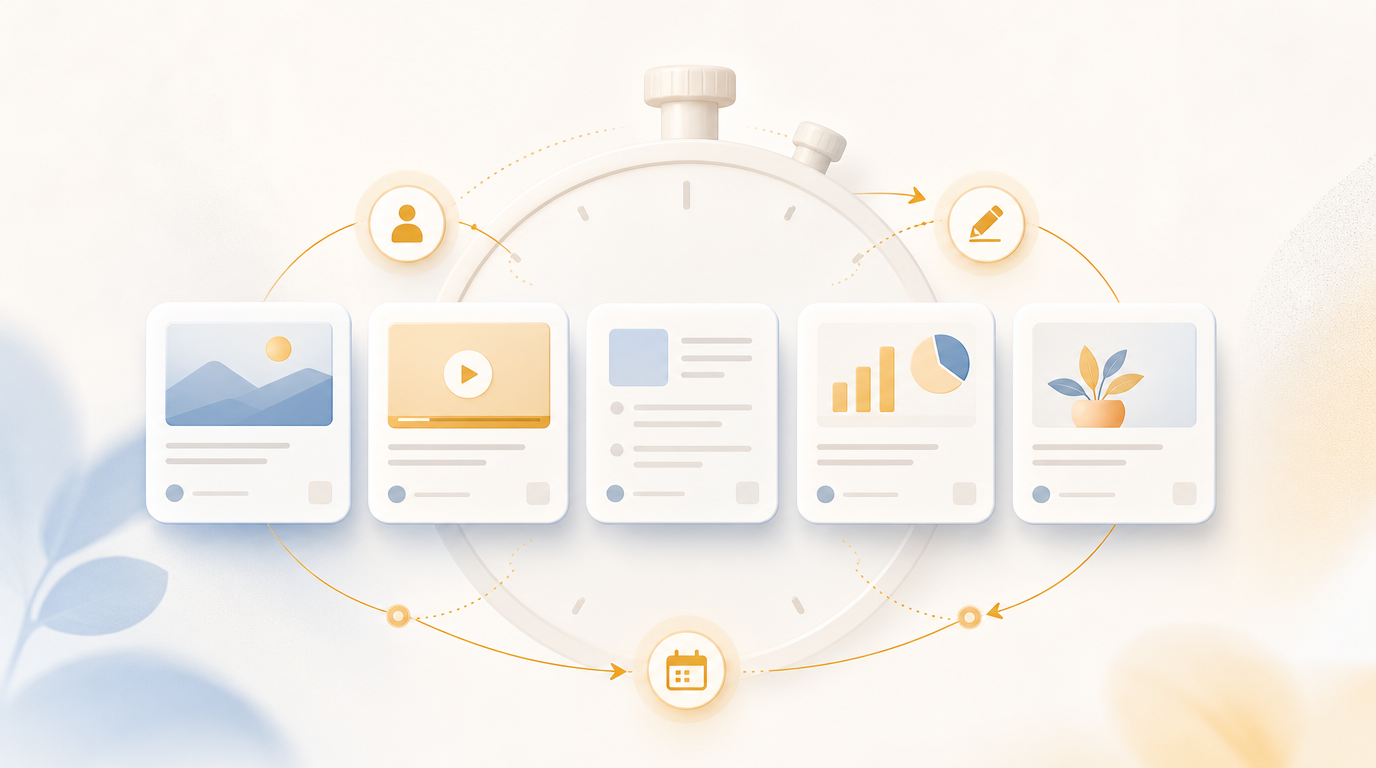
Growth agent loop: understand the product → collect market signals, competitor moves, community threads, buyer objections → judge what's worth acting on → create channel-native content — posts, blogs, FAQs, landing copy → publish or queue for review → learn from channel history and engagement signals → repeat.
In both cases, the agent isn't responding to a one-shot prompt. It's running a system — observing a state, acting, evaluating, and continuing toward a goal.
The Four Growth Loops VibeCom Runs
VibeCom combines several loops into a continuous marketing system:
Market signal loop — The collect agent scans for industry news, competitor moves, community conversations, and buyer objections. It surfaces what's relevant to the product and its audience, so there's always fresh, grounded material to work from.
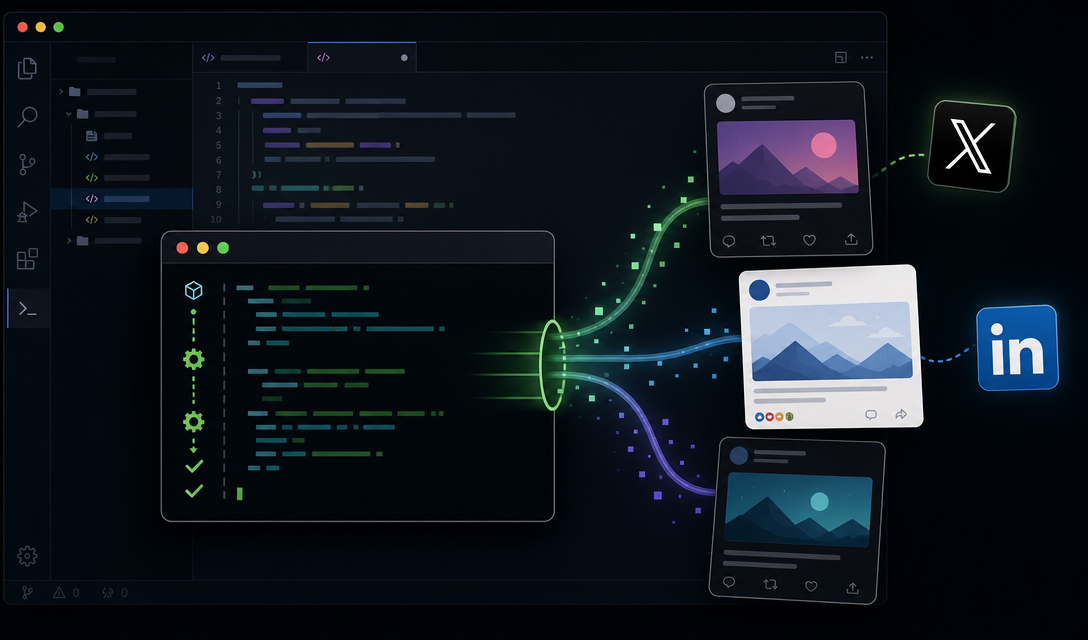
Content loop — Saved materials (product updates, customer signals, market insights, launches) feed the generate skill. It drafts channel-native posts, blog articles, and other assets, calibrated to each channel's language, tone, and recent history. Posts go to a queue for review before publishing.
SEO/GEO loop — The keyword and page audit identifies gaps between what the product should rank for and what it currently does. Recommendations surface with specific, implementable prompts. As pages improve, the loop repeats — discovering new opportunities.
Publishing loop — Approved posts move through a queue, get scheduled at optimal times, and publish. History accumulates. The next content round is informed by what's already been said — preventing repetition and building a coherent voice over time.
None of these loops require a full-time marketing hire to operate. That's the point.
What Loop Engineering Changes for Founders
For the past two years, the standard advice to technical founders on marketing was some version of: "Use AI tools to write faster." Better prompts, better copy, more content with less effort.
That advice was about phase one and two — prompt engineering and context engineering. It treated AI as a smarter writing assistant.
Loop engineering is a different category of thinking. The question is not "how do I get a better blog post from this prompt?" It's "how do I design a system that keeps my marketing moving — gathering signals, creating assets, publishing, and improving — without me manually initiating every step?"
For a solo founder or small team, that shift matters. Marketing is not a one-shot task. It's a repeated system. And repeated systems benefit from loop engineering the same way repeated coding tasks do.
The Practical Difference
Here's what the shift looks like in practice:
Without a growth loop: A founder ships a feature. They write one announcement post. They move on to the next build cycle. Three weeks pass. The announcement is buried. No follow-up content explored what the feature actually solves. No SEO page was created. No competitor angle was covered. The marketing stopped when the founder stopped.
With a growth loop: The feature launch is saved as a material. The Growth Agent generates platform-specific posts across channels, a blog draft exploring the use case, and flags whether a competitor recently shipped something similar. The SEO agent checks whether the relevant keyword has a landing page. Everything queues for review. The founder approves what's good, rejects what isn't, and the loop moves forward.
The product didn't change. The system did.
A Note on the Limits
Loop engineering in any domain doesn't eliminate judgment. It moves judgment to a higher level.
Osmani is explicit about this in coding: high token costs, the risk of loops drifting from the actual goal, and the need for human verification at key checkpoints. A coding loop without a reliable verifier is a loop that confidently ships bugs.
The same applies to marketing. A growth loop without a clear product voice, accurate materials, and human review will produce volume without quality. VibeCom's design reflects this — posts go to a pending review queue. The human approves, rejects, or edits. The loop provides the momentum; the founder provides the judgment.
This is not a compromise. It's the model that doesn't spiral.
The Shift That's Coming
Loop engineering will define how serious AI agents work in 2026 and beyond — not just in coding, but across any knowledge workflow that repeats. Marketing is one of the most obviously repeating, signal-intensive workflows a small team has to run.
The choice for a solo founder or small team isn't between marketing and not marketing. It's between a marketing loop that runs consistently and one that stops every time the founder runs out of time or energy.
If you're building something real and finding that marketing feels slow, lonely, and inconsistent, VibeCom Growth Agent is worth looking at. It's at .