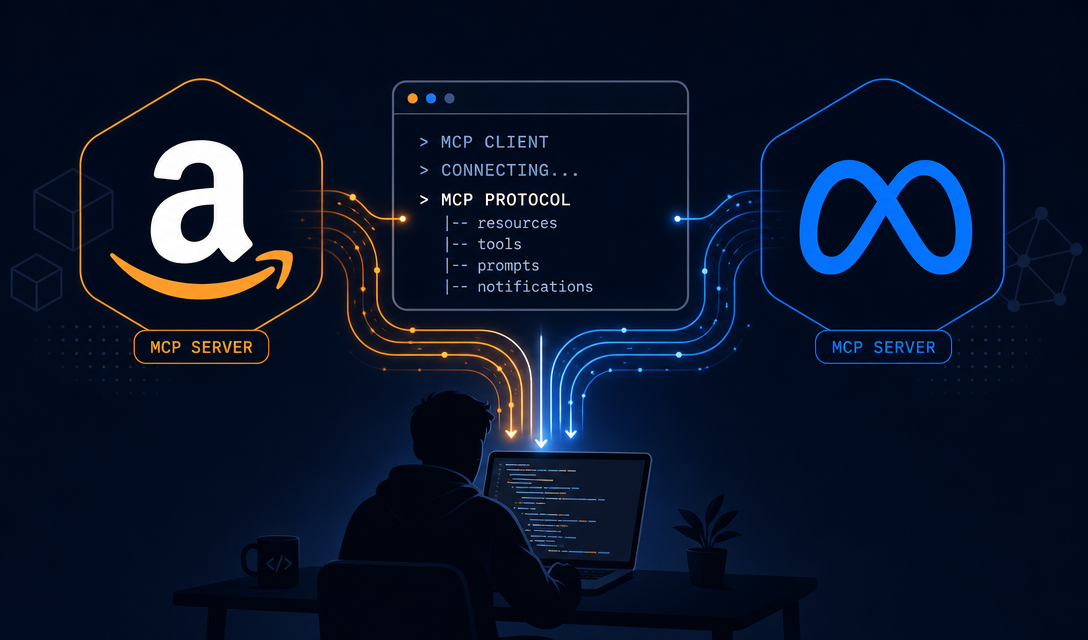
In the last three weeks, two of the largest advertising platforms on earth shipped MCP servers in open beta.
Amazon Ads went first. Their server lets an AI agent create a campaign, configure ad groups, and launch ads in a single prompt — collapsing what used to be a 3-step manual process into one natural language command. Meta followed, connecting ad accounts directly to Claude and ChatGPT.
If you're a solo technical founder, your first instinct might be: "cool, now I can run ads without a dashboard." That's the surface read.
The deeper read is more useful.
Why the Biggest Platforms Are All Going MCP-Native
MCP — the Model Context Protocol — has become the default interface layer between AI models and the tools that used to require browser tabs. AWS hit general availability in May. Chrome DevTools shipped an official MCP server. Klaviyo connected their marketing database directly to Claude. Twilio added MCP at SIGNAL 2026.
Forbes Technology Council called it "an infrastructure play nobody's talking about."
The pattern is consistent: every tool that used to require context-switching is migrating into the AI workflow. The reason isn't novelty. It's friction.
Dashboards require you to leave what you're doing, reload your mental context, and operate in someone else's interface. MCP servers let the AI operate the tool on your behalf, inside the workflow you're already in.
Amazon and Meta didn't ship MCP servers because it was technically interesting. They shipped them because reducing friction in their ad platforms directly increases spend. Their incentive is commercial. But the benefit flows to users.
What This Means If You're Building Solo
For indie hackers and solo founders, there's a more concrete implication here: the tools you use to grow your product are moving in exactly one direction.
Not toward shinier dashboards. Toward your existing workflow.
The $39B social media management market is dominated by web tools — Hypefury, Tweet Hunter, Typefully, Buffer — that were built when the browser was the only viable interface. Every one of them requires you to context-switch out of your IDE, open a tab, manually explain your product to an AI, and hope the output sounds like you.
That assumption is cracking. Amazon and Meta just validated it at scale.
When the largest ad platforms on earth decide the right interface is "AI reads your account context and operates it through natural language," they're signaling something broader: context-in, action-out is the new model for all marketing tooling.
The Gap This Exposes for Technical Founders
Here's what the Amazon and Meta MCP launches don't solve: the content problem.
Managing an ad campaign through Claude is genuinely useful. But the upstream question — what to say, how to position yourself, what to post consistently across X, LinkedIn, and a blog while you're heads-down building — that's not an ad platform problem. It's a distribution problem.
And it's one that existing MCP marketing tools haven't addressed for the solo founder specifically.
The pain points are documented:
- A thread on r/vibecoding (248K subscribers) surfaced it clearly: building is solved, distribution is the boss fight
- r/DigitalMarketing consensus: "feeds are saturated; the shift is toward fewer pieces with stronger positioning, not more volume"
- A founder on Indie Hackers put it plainly: they had to "actively force" themselves out of the code to focus on top-of-funnel
The solution isn't another dashboard. It's the same principle Amazon and Meta just applied to ads: bring the tool into the workflow.
What an IDE-Native Marketing Stack Actually Looks Like
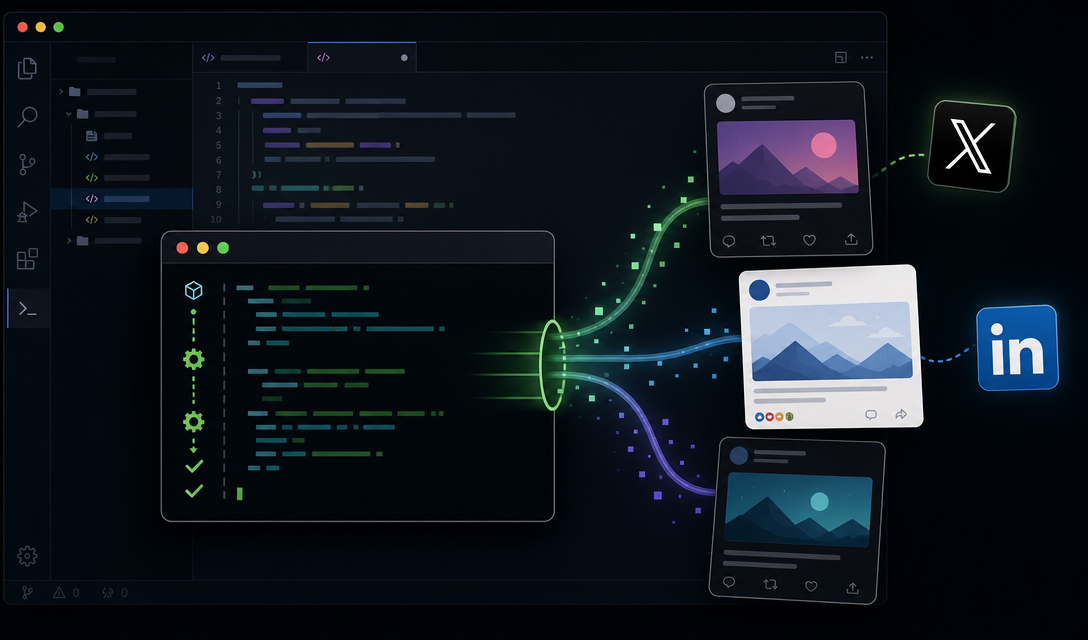
This is what Growth Autopilot was built to do. It runs as an MCP server inside Cursor, Claude Code, or VS Code — the same IDEs where technical founders already spend their day.
Instead of requiring you to describe your product in a chat box, it reads your codebase, commits, and product context directly. The content it generates isn't generic because the input isn't generic. Every post is grounded in what you actually shipped, not what you remembered to type.
The workflow:
- You ship something — a feature, a fix, a decision
- The agent collects materials from your actual product context
- It generates platform-native posts for X, LinkedIn, and your blog — each written for that platform's culture, not cross-posted
- You spend 5 minutes in a review queue: approve, tweak, or skip
- Posts auto-schedule and publish
No tab switch. No blank box. No broken flow.
At $99/month, it's priced alongside Tweet Hunter and Hypefury — tools that require you to manually manage everything they offer. The difference is the workflow model.
The Broader Signal
Amazon and Meta going MCP-native for ads isn't just a product launch. It's confirmation that the browser-as-default-interface assumption is ending for marketing tools, the same way it ended for coding tools when Cursor crossed $2B in annualized revenue.
Solo founders who understand this now have a window. The category is early. The habits aren't formed yet. The founders who build an MCP-native marketing workflow today — where their content comes from their actual work, not a separate content creation effort — will compound in distribution while everyone else is still context-switching.
Amazon and Meta just made the argument for you.
VibeCom is the MCP-native growth platform for solo technical founders. Growth Autopilot lives in your IDE so you never have to leave your code editor to grow your product.