Cursor crossed $2 billion in annualized revenue in early 2026. It doubled in three months. One million paying customers. The fastest-growing SaaS product in history — built entirely around one idea: make shipping code feel effortless.
It worked. In 2026, 84% of developers use AI tools that write 41% of all code. Building has never been faster, cheaper, or more accessible.
And yet, 99% of solopreneurs still cite marketing and distribution as their #1 problem.
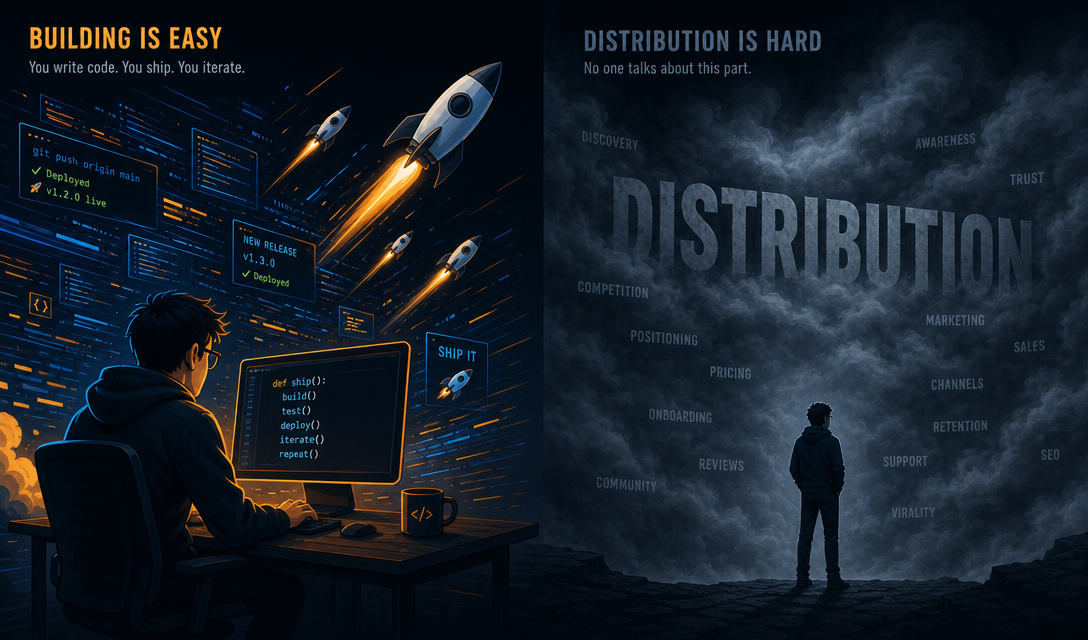
That's not a coincidence. That's a bottleneck shift — and most vibe coders haven't noticed it yet.
What Changed (And What Didn't)
Here's the thing about bottlenecks: fixing one just reveals the next one.
In 2023, writing code was hard. Learning a new framework took weeks. Debugging across files took hours. The slow part was building.
AI tools fixed that. Genuinely. A single developer with Cursor and Claude Code today can out-ship an early-2020s dev team. The technical barrier to launching a product is lower than at any point in the history of software.
But the distribution barrier? Unchanged.
A Deloitte 2025 Tech Value Survey found that AI-assisted companies generate 451% more leads than those relying on manual methods. The gap between founders who automate distribution and those who don't is widening — fast. Meanwhile, customer acquisition costs have risen 60% between 2021 and 2026.
Building got 10x easier. Getting found got 60% more expensive.
The Hours Problem
Here's a data point that stops most technical founders cold: indie hackers spend 40+ hours automating their product and under 4 hours automating customer acquisition.
Not 40 hours vs. 40 hours. 40 vs. 4. A 10:1 ratio.
This isn't laziness. It's the nature of the tools. Every AI coding tool, every IDE extension, every deployment automation — all of it is optimized for the build side. The feedback loop is tight: write prompt → see code → ship. Satisfying, fast, measurable.
Marketing feels like the opposite. Write a post → wait → maybe an impression. The feedback is slow, the process is disconnected from the work, and — crucially — none of your IDE-native tools know what you're building.
So founders do what's natural: they keep optimizing the part that feels productive.
Why Social Media Automation for Indie Hackers Keeps Failing
Every founder I've talked to has tried at least one social media automation tool. And almost every one of them abandoned it within 60 days.
The pattern is consistent:
- Sign up for the tool
- Open a blank draft box
- Realize the tool knows nothing about what you're building
- Write something generic
- Post it, get mediocre results
- Stop posting entirely
The problem isn't discipline. It's friction and context.
Every social media scheduler — Tweet Hunter ($49–$99/mo), Hypefury ($29–$97/mo), Typefully ($8–$39/mo) — requires you to leave your IDE, open a browser tab, and manually explain your product to an AI that has never seen your codebase. The content comes out generic because the input is generic.
Generic content fails twice: it doesn't perform well on social platforms (platforms penalize low-engagement posts), and it doesn't reflect what you actually built (which erodes trust when readers show up).
72% of successful indie hackers say distribution — not product — was the deciding factor in their success. But the tools designed to help with distribution actively fight the builder's workflow.
The Shift That Actually Matters
The developer community spotted the root cause before the tools caught up.
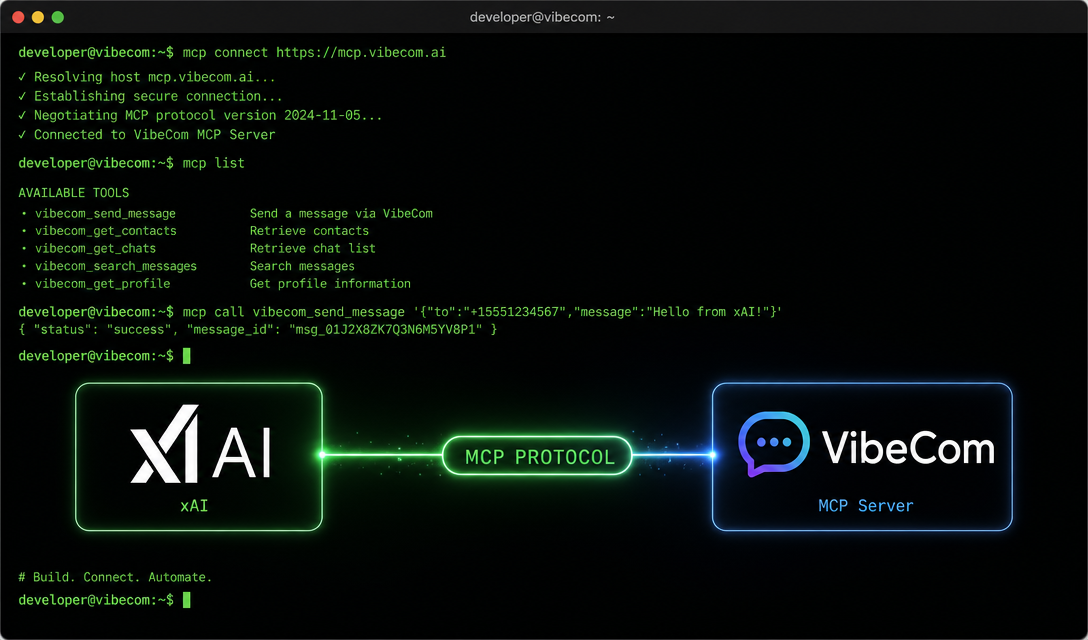
In 2026, the Model Context Protocol (MCP) achieved near-universal adoption across the AI stack. Anthropic, OpenAI, Google, and Microsoft all have native MCP support. Cursor, Claude Code, and Continue support MCP server plug-ins out of the box. The protocol works like USB-C for AI — connect any model to any data source or tool without custom integration.
Every category of developer tooling is moving inside the IDE. Database tools, ad platforms, CRMs — they're all building MCP servers because that's where technical founders work.
Marketing is the last category that hasn't made the move.
That's the insight behind VibeCom's Growth Autopilot. Instead of asking a founder to leave their IDE and describe their product to a blank box, the agent reads the product context directly — codebase, commits, milestones, materials — and generates native content for 10+ platforms automatically. You spend 5 minutes in a review queue. Everything else is handled.
The model is the same as what happened with deployment automation. Founders used to FTP files manually. Then Heroku happened, and nobody thought about deploys the same way again.
Distribution is in the FTP era. It's still mostly manual, mostly disconnected from the build, and mostly abandoned when founders get busy.
What Actually Works for Vibe Coders in 2026
The founders breaking through the distribution wall share a few common patterns:
Automate capture, not just publishing. The biggest failure mode is having nothing to say. If you're not capturing what you build as you build it — feature decisions, things that broke, customer responses — no scheduler in the world helps. The content has to start somewhere real.
Native content beats cross-posting. A 2026 study of solo social media managers confirmed what most founders suspect: cross-posting the same content across 5 platforms hurts more than it helps. Each platform has distinct algorithms, audiences, and formats. A LinkedIn post is not an X post. An X thread is not a blog paragraph. Tools that can't generate natively per platform produce content that performs like cross-posting, even if it's technically different words.
Consistent beats occasional. The r/vibecoding community, now at 248K subscribers, has a recurring theme: founders who post consistently — even mediocre content — out-distribute founders who post occasionally but polish each piece. Compound effects require compounding inputs.
Community channels convert better than broadcast. One founder who reached 15K active users in 8 weeks with $0 in ads described their strategy: Reddit as spark, SEO/AEO as the compounding engine. Not Product Hunt launches or mass X posts — targeted presence in niche communities where the ICP already hangs out.
The Honest Takeaway
If you're a vibe coder and you've shipped something in the last 90 days that didn't get the attention you expected, the question worth asking isn't "was the product good enough?"
It's: "How many hours did I spend on distribution vs. building?"
If the ratio looks anything like 10:1 in favor of building, you have your answer.
The tools to fix this exist. The question is whether you'll treat distribution with the same engineering discipline you apply to the build side — or keep handing it to luck.
Growth Autopilot is our attempt to make the second option untenable. One MCP server, your IDE, 5 minutes a day.
The build side is solved. Distribution is next.