I hired my first employee at my last startup when we hit $30K MRR. It felt like a milestone — the moment you stop being a solo project and start being a real company.
I'm building VibeCom differently. Six months in, zero employees. And I don't plan to hire anyone until well past $500K ARR.
That number would have sounded insane to me two years ago. It's becoming normal.
The Model That's Quietly Reshaping Startups
Pancake, a company that builds AI tools for founders, published something in June that stopped me mid-scroll: solo founders using AI to replace their first five hires are reaching $1M ARR with zero full-time employees. They're delaying first hires by 12 to 18 months compared to the traditional startup playbook.
The five roles being replaced:
- Sales/BDR — AI handles 500+ prospects simultaneously, qualifies leads, and manages follow-up sequences
- Marketing/Content Lead — AI executes SEO, blog writing, and social scheduling
- Operations Manager — AI manages systems, data hygiene, and workflow automation
- Customer Success Lead — AI handles onboarding flows and churn prevention triggers
- Finance/Admin — AI manages payroll, bookkeeping, and compliance
The founder keeps the high-stakes work: closing deals, strategic positioning, complex negotiations. Everything else runs through agents.
The numbers back this up. Solo founders are reaching $500K ARR alone — up from $50K in the old model where you'd hire specialists at each revenue milestone. Founding teams are staying at two people instead of five, treating AI as a team with separate roles, clear ownership, and distinct KPIs rather than productivity software.
The Math That Makes This Possible
Let me put real numbers on this.
A traditional early-stage startup at $500K ARR might carry:
- Sales hire: $60K base + $30K commission
- Marketing hire: $70K
- Operations: $55K
- Customer success: $50K
- Finance/Admin: $45K (or fractional at $2K/month)
That's roughly $300K in annual salary costs before benefits, before office, before tooling. At $500K ARR, you're spending 60% of revenue on headcount alone.
The AI stack replacing those five roles:
- Sales agent: $50–200/month
- Marketing agent (VibeCom): $20–100/month
- Operations automation: $30–100/month
- CS automation: $50–200/month
- Finance/Admin tools: $50–150/month
Total: roughly $200–750/month. $2,400–9,000/year. Less than 2% of $500K ARR.
The gap between $300K and $9K isn't incremental. It's structural. It changes what a "lean startup" even means.
What I'm Actually Doing With This
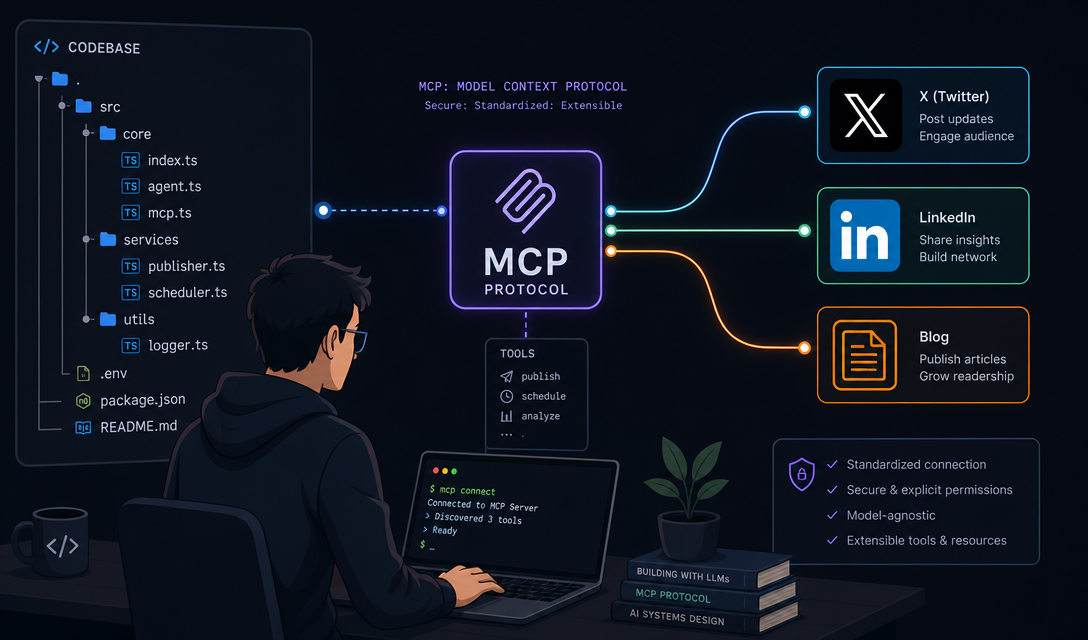
VibeCom is the marketing component of this stack. When I talk to founders about what we're building, I explain it this way: you've got AI handling your code (Copilot, Cursor, Claude). You've got AI handling your operations. What's handling your marketing?
Most founders I talk to answer the same way: "Nothing. It stops when I stop."
That's the specific problem VibeCom solves. Not "AI writes your tweets" — every tool does that. The real thing is continuity: marketing that keeps moving when you go heads-down building, because there's an agent system that knows your product, your voice, your materials, and your channels.
The Pancake data validates the model. The $500K-solo stat proves it's not theoretical. Founders are already doing this — they're just missing the marketing piece.
The Counterargument (And Why It's Wrong)
The obvious pushback: "But AI content is generic. AI outreach is spammy. You need a human for real marketing."
I agree with half of this.
The AI copywriter replacement story is real — email open rates dropping from 31% to 24% when a business replaced their human writer with raw AI. The researcher who documented it put it perfectly: "AI is brilliant at producing an average version of everything and useless at producing the specific version of your thing."
But that's an argument for better AI, not no AI. The variable that determines whether AI marketing works is context: does the system hold your product positioning, brand voice, customer stories, and competitive landscape? Or does it start from zero every session?
Generic AI produces generic output. Context-aware AI — the kind that builds a knowledge base of your product before it writes anything — closes the gap between average and yours.
That's the difference between replacing a human with ChatGPT and replacing a human with an agent system that knows your business.
What This Means If You're Building Alone
If you're a solo founder reading this, here's the practical takeaway: the "I'll hire when I hit X revenue" milestone has moved. It used to be $50K ARR for the first hire. Now it's $500K. Soon it'll be $1M.
This isn't about being cheap. It's about keeping more revenue as you grow, which means you can grow faster, which means you hit escape velocity sooner.
The playbook:
- Map your first five hires
- For each one, ask: can AI handle 80% of this at 10% of the cost?
- For the roles where the answer is yes, deploy the AI version now
- Keep the high-stakes decisions for yourself
- Hire humans only when the AI version is actively losing you money — not before
I'm running this playbook in real time. VibeCom is the marketing piece. I'll write more about the other four as I deploy them.
The era of the $1M solo business isn't coming. It's already here. The only question is whether your marketing keeps running while you build it.