In March 2026, MCP SDK downloads crossed 97 million per month. That's a 970x increase in 18 months.
10,000+ public MCP servers. 300+ clients. 78% enterprise AI team adoption. 67% of CTOs have designated it as their default agent-integration standard.
The protocol that lets AI agents talk to tools — not just read about them, but actually use them — has reached mainstream adoption faster than most enterprise standards reach pilot.
And buried in that data is one number worth paying attention to: marketing automation accounts for 9% of the public MCP server registry.
For solo founders doing growth, that's a signal.
What MCP Actually Changes
Before MCP, building an agent that could compose a post, check your recent post history, pick fresh material, and publish to three platforms required significant custom glue code. You'd wire up APIs, manage state between calls, handle auth for each platform separately.
MCP standardizes the agent-to-tool handshake. An MCP-native marketing agent can access your product context, query your content history, pull from a live material library, and publish — all in one agent loop, without platform-specific brittle integrations.
Average SaaS integration time fell from 18 hours to 4.2 hours with MCP. That's not incremental. That's a category shift in what a solo developer can build and maintain.
Why AI Content Still Underperforms
Here's the uncomfortable data sitting next to the adoption numbers: AI has improved productivity for 87% of content marketers, but only 4% consider AI-generated content indistinguishable from human-written content. And 12–13% report decreased content quality from over-relying on automation.
The productivity win is real. The content quality problem is also real.
The gap between the two is where most solo founders get stuck. They generate fast. They publish mediocre. The content doesn't compound because it doesn't earn readers — it just fills the queue.
The root cause isn't the AI model. It's that most AI writing tools don't know anything specific about your product. They generate from a generic prompt, not from real materials: your shipped features, your metrics, your actual opinions. The output is fluent but hollow.
This is the structural problem MCP-native marketing agents are positioned to solve. When an agent has access to your product database, your post history, your competitive context — not as a prompt, but as live tool calls — the content it generates has something to say.
The 9% That Matters
Marketing automation at 9% of the MCP registry means two things:
First, the infrastructure exists. Agents can already connect to publishing APIs, CMS platforms, SEO tools, and social schedulers via MCP. The plumbing is done.
Second, the application layer is early. Most of those 9% are wrappers around existing martech tools — scheduled posting, basic drafts. Very few have solved the content quality problem: generating platform-aware, product-specific content that a founder would actually approve.
Solo founders benefit from this gap being early. The cost curve is favorable — the models are cheap enough now that a 5-minute morning review queue is economically viable. The distribution is available — X and LinkedIn APIs are accessible. The missing piece is the intelligence layer: an agent that knows your product well enough to generate content you'd actually publish.
What This Looks Like in Practice
The old workflow: Open a blank document. Stare at it. Think of something. Write something generic. Realize it sounds like every other founder's LinkedIn post. Close the tab. Post nothing. Repeat tomorrow.
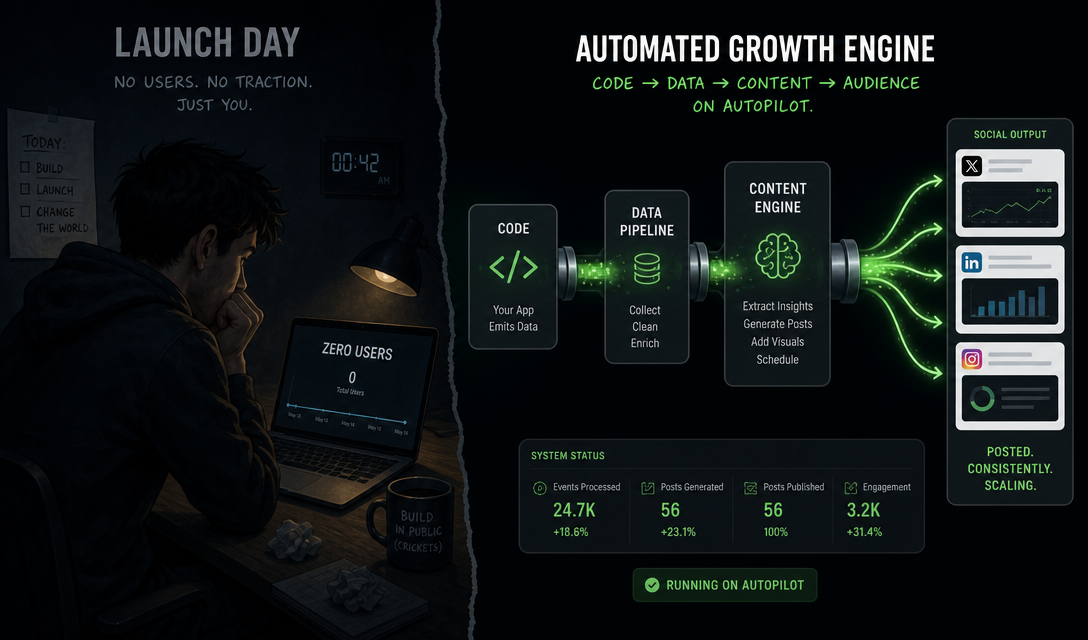
The MCP-native workflow: An agent wakes up each morning, scans your product context and recent materials, checks what you've already covered in the last 60 days, generates platform-specific drafts for each active channel, and surfaces them for a 5-minute approval pass.
The content is grounded in real facts — your metrics, your feature launches, your industry signals. It's adapted to each platform's format and tone. It avoids topics you've already covered. It shows up in your queue, not your to-do list.
Solo founders spent 20–30% of their week on marketing before AI tools. The 2026 target should be under 10% — not because marketing matters less, but because the right tooling compounds. A 5-minute review queue daily is 25 minutes a week. That's the math MCP-native marketing makes possible.
The Practical Takeaway
If you're a solo founder doing content marketing:
- The infrastructure (MCP, publishing APIs, cheap LLMs) is in place.
- The content quality problem is real and mostly unsolved by existing tools.
- The window for early-mover advantage in AI-native marketing tooling is narrow — the +58% QoQ growth rate on MCP server adoption won't stay early-stage for long.
The question isn't whether AI marketing automation is viable in 2026. It clearly is. The question is whether the tool you're using knows enough about what you've actually built to generate something worth reading.
Data sources: knak.com MCP adoption report (April 2026), digitalapplied.com MCP statistics (April 2026), omnibound.ai content marketing report (April 2026), startup.info solo founder content stack survey (May 2026).